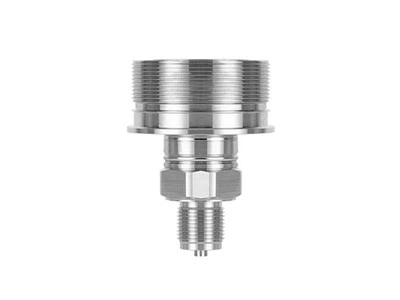
In the realm of industrial instrumentation, level transmitters play a crucial role in accurately measuring the level of liquids or solids in tanks, vessels, and other containers. A key aspect of a level transmitter's functionality is its signal conversion methods, which are essential for translating the physical level measurements into electrical signals that can be read, processed, and utilized by control systems. As a leading supplier of level transmitters, we deeply understand the significance of these signal conversion techniques and their impact on the performance and reliability of the entire measurement system.
1. Understanding Level Transmitters and Signal Conversion
Level transmitters are designed to measure the level of substances within a defined space and convert this information into a more usable form. The basic principle behind a level transmitter involves sensing the level and then converting that physical quantity into an electrical signal, such as a voltage, current, or digital signal. This conversion is necessary because most control systems and monitoring devices rely on electrical signals to process and display data.
There are several types of level transmitters, including ultrasonic, radar, capacitive, and hydrostatic. Each type has its own unique way of measuring the level, but they all share the common need for signal conversion. For example, an ultrasonic level transmitter emits ultrasonic waves towards the surface of the liquid or solid and measures the time it takes for the waves to bounce back. This time measurement is then converted into a level measurement and further into an electrical signal.
2. Common Signal Conversion Methods
2.1 Analog Signal Conversion
One of the most widely used signal conversion methods in level transmitters is analog signal conversion. In this method, the level measurement is converted into a continuous electrical signal, typically a current or voltage. The most common analog signal used in industrial applications is the 4 - 20 mA current signal.
The 4 - 20 mA signal has several advantages. First, it is relatively immune to electrical interference, making it suitable for long - distance transmission. Second, the 4 mA signal can be used to indicate a zero or minimum level, while the 20 mA signal represents the maximum level. This allows for easy identification of faults, as a signal below 4 mA or above 20 mA can indicate a problem with the transmitter or the measurement system.
For example, in a hydrostatic level transmitter, the pressure exerted by the liquid column is proportional to the liquid level. The pressure sensor in the transmitter converts this pressure into an analog voltage signal, which is then conditioned and converted into a 4 - 20 mA current signal. This signal can be sent to a control room or a data acquisition system for further processing and monitoring.


2.2 Digital Signal Conversion
With the advancement of technology, digital signal conversion has become increasingly popular in level transmitters. Digital signals are discrete, binary - based signals that offer several advantages over analog signals. They are more accurate, less prone to noise, and can carry more information.
One common digital communication protocol used in level transmitters is HART (Highway Addressable Remote Transducer). HART combines analog and digital communication, allowing the 4 - 20 mA analog signal to be used for basic level measurement while the digital signal can be used to transmit additional information such as diagnostic data, calibration parameters, and configuration settings.
Another popular digital protocol is Modbus. Modbus is a serial communication protocol that allows multiple devices to communicate over a single network. Level transmitters with Modbus output can be easily integrated into a larger industrial control system, allowing for centralized monitoring and control.
For instance, our SP38M UART Output Multivariable Sensor utilizes digital signal conversion techniques to provide accurate and reliable level measurements. It can output data in a digital format, which can be easily interfaced with various control systems and software applications.
2.3 Frequency Signal Conversion
In some level transmitters, frequency signal conversion is used. The level measurement is converted into a frequency signal, where the frequency of the signal is proportional to the level. Frequency signals are often used in applications where the measurement needs to be transmitted over a long distance or where a high - resolution measurement is required.
For example, in some capacitive level transmitters, the change in capacitance due to the level change is converted into a frequency signal. This frequency signal can then be transmitted to a receiver, where it is converted back into a level measurement.
3. Signal Conversion Components and Considerations
3.1 Signal Converters
To perform the signal conversion, level transmitters typically use signal converters. These converters can be integrated into the transmitter or can be external devices. Signal converters are designed to amplify, filter, and linearly convert the raw sensor signal into the desired output signal.
For example, an analog - to - analog converter can be used to convert a low - level voltage signal from a sensor into a 4 - 20 mA current signal. Digital - to - analog converters (DACs) and analog - to - digital converters (ADCs) are used in digital signal processing to convert between digital and analog signals.
3.2 Calibration
Accurate signal conversion requires proper calibration of the level transmitter. Calibration ensures that the output signal is directly proportional to the actual level measurement. Most level transmitters can be calibrated either in the field or in a laboratory setting. During calibration, known levels are applied to the transmitter, and the output signal is adjusted accordingly.
3.3 Compatibility
When selecting a level transmitter, it is important to consider the compatibility of the signal conversion methods with the existing control system and monitoring devices. For example, if the control system only accepts 4 - 20 mA signals, then a level transmitter with a 4 - 20 mA output should be selected. Similarly, if the system uses a specific digital communication protocol, such as Modbus, the transmitter should be compatible with that protocol.
4. Our Products and Their Signal Conversion Capabilities
As a reputable level transmitter supplier, we offer a wide range of products with advanced signal conversion capabilities.
Our LCD11 Field Display Instrument is a versatile device that can be used in conjunction with various level transmitters. It can receive different types of signals, including analog and digital, and provide a clear visual display of the level measurement. The instrument also supports signal conversion and can be configured to output the desired signal format, making it suitable for a variety of industrial applications.
The SMP131 - TSD - S Gauge Pressure Transmitter is another one of our high - quality products. It uses advanced signal conversion techniques to convert the pressure measurement, which is related to the liquid level, into an accurate electrical signal. It supports both analog and digital output options, providing flexibility for different system requirements.
5. Contact Us for Procurement
If you are in the market for reliable level transmitters with efficient signal conversion methods, we are here to help. Our team of experts has extensive knowledge and experience in the field of level measurement and signal conversion. We can provide you with customized solutions tailored to your specific application requirements.
Whether you need a level transmitter for a small - scale project or a large - scale industrial installation, we have the right products and expertise to meet your needs. Contact us today to discuss your procurement requirements and take the first step towards improving the accuracy and reliability of your level measurement systems.
References
- Beckwith, T. G., Buck, N. L., & Marangoni, R. D. (2007). Mechanical Measurements. Addison - Wesley.
- Doebelin, E. O., & Shepherd, D. L. (2011). Measurement Systems: Application and Design. Wiley.
- Fraden, J. (2016). Handbook of Modern Sensors: Physics, Designs, and Applications. Springer.