Process and Material Selection Design for the Sensing Diaphragm of Pressure Transmitters
CIP cleaning is predominantly used in hygienic applications, requiring materials that comply with relevant national hygiene standards. The sensing diaphragm of a pressure transmitter comes into direct contact with the medium, necessitating materials that meet hygiene requirements. Most domestic and international pressure transmitter manufacturers use 316L as the diaphragm material. 316L offers excellent and stable corrosion resistance, temperature tolerance, and elastic recovery properties. However, under rapid temperature changes, its recovery time is prolonged, leading to significant measurement errors. Across the domestic CIP cleaning equipment industry, most manufacturers' products face this issue, resulting in the dominance of process control instruments by leading foreign companies. To address this problem, we urgently need to find viable solutions. Below, we explore the feasibility from two aspects: diaphragm process design and material selection.
Diaphragm Process Design:
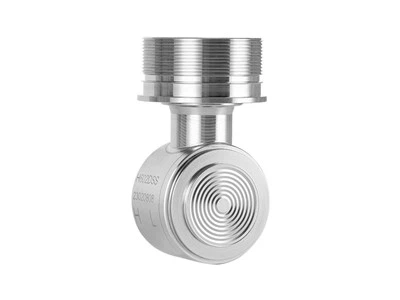
As a pressure-transmitting contact component, the sensing diaphragm is typically corrugated to maintain elasticity. There are two common methods for forming these corrugations:
1.The diaphragm is first molded and then welded to the process connection.
2.The diaphragm is welded to a corrugated process connection and then formed under high pressure.
Regardless of the method, deformation during forming introduces internal stresses, making stress relief an essential part of transmitter manufacturing. Typically, high-temperature fatigue aging is used for stress relief. However, due to process limitations, most factories only perform stress relief below 100°C, which suffices for transmitters under stable temperature conditions.
When used in CIP cleaning applications, the diaphragm is subjected to rapid temperature fluctuations, causing residual stresses to shift unpredictably and generate additional stresses, leading to measurement inaccuracies. To fully eliminate these stresses, higher temperatures and longer fatigue aging periods are required. Long-term comparative experiments at various stress-relief temperatures indicate that 316L diaphragms achieve optimal stress relief when subjected to 12+ hours of thermal fatigue testing at 200–300°C under vacuum. This significantly reduces pressure transmitter accuracy deviations caused by sudden temperature changes.
Material Design Exploration for Sensing Diaphragms:
Bimetallic strips utilize the differing thermal expansion coefficients of two materials, arranged in a special structure to convert thermal expansion/contraction into contraction/expansion, thereby counteracting temperature effects. They are widely used in mechanical pressure gauges with temperature compensation.
Inspired by this, if pressure transmitter diaphragms adopt a bimetallic material design, the deformation effects of rapid temperature changes could offset each other, maximizing measurement accuracy. However, domestic material manufacturers have yet to research or apply this concept, necessitating greater investment in fundamental materials and applications to address existing challenges.
Currently, foreign manufacturers have developed TempC diaphragm material, which has extremely low hardness. It absorbs and neutralizes the impact or contraction of fill fluid, avoiding additional measurement errors. Moreover, under rapid temperature changes, TempC diaphragms recover their original state much faster than traditional diaphragms. As shown in Figure 4, when subjected to temperature variations, a conventional diaphragm undergoes deformation in a single direction. This unidirectional movement transmits force to the sensing silicon chip, resulting in measurement inaccuracies in the transmitter. In contrast, Figure 5 illustrates that under thermal influence, the TempC diaphragm generates two opposing deformation movements. This counteracting effect neutralizes the stresses induced by temperature changes, making it suitable for applications involving rapid thermal shocks. Consequently, it meets the stringent requirements of CIP cleaning processes, ensuring reliable and precise measurements.