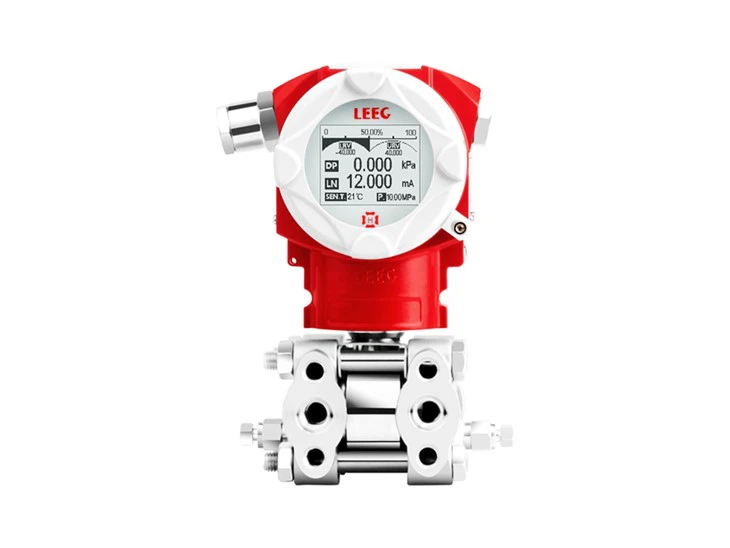
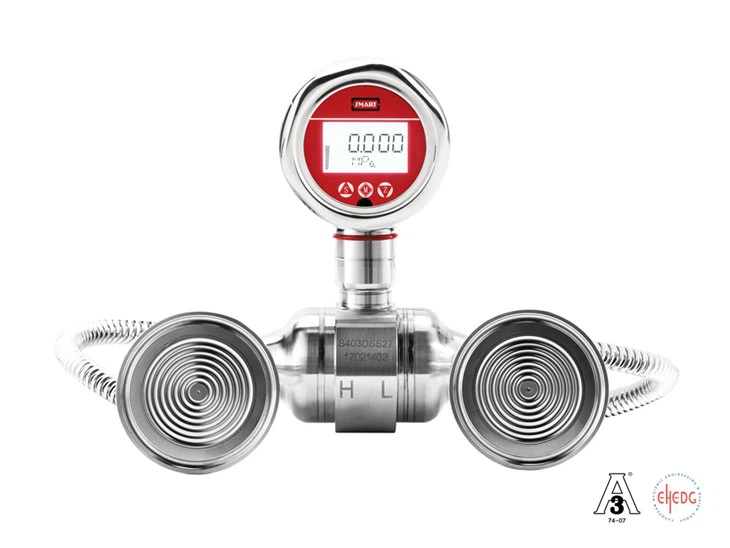
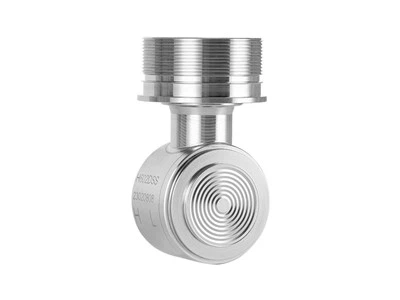
The pressure level transmitter is an extension of the pressure transmitter adapted for level measurement. It converts static pressure into an electrical signal through a pressure sensor, then outputs the electrical signal after temperature compensation and linear correction. The pressure generated at different heights exhibits a linear relationship with the specific gravity of the liquid. It is mainly used to measure water, oil, and other mixed liquids. Key application industries include petrochemical, water treatment, municipal environmental protection, and marine engineering. Common output methods in the petrochemical industry are HART, RS-485, and 4-20mA, while 4-20mA is the standard output for municipal environmental protection and similar industries.
Flange-Mounted Level Transmitter
Flange-mounted level transmitters are categorized into single-flange and double-flange remote transmitters. Single-flange types are typically used for open-container level measurement, while double-flange types are designed for sealed containers. The single-flange variant is installed at the container's base, where the flange diaphragm transmits pressure via a capillary tube to the transmitter's measuring chamber, converting the liquid level signal into an electrical output for display and control. The double-flange type has its high-pressure end mounted at the container's bottom and the low-pressure end at the top; the liquid level height is calculated based on the hydrostatic pressure differential. LEEG Instruments' flange-mounted level transmitters are certified to international standards such as CSA, IECEx, and ATEX, ensuring measurement safety. With two decades of experience and hundreds of thousands of field installations, they guarantee high accuracy and stability.


Submersible Level Transmitter
Submersible level transmitters operate on the principle that hydrostatic pressure is proportional to liquid height. They typically use the piezoresistive effect of diffusion or monocrystalline silicon to measure hydrostatic pressure, which is then amplified and converted into standard current/voltage signals. A linear relationship between the output signal and liquid depth is established, enabling precise measurement with temperature compensation. The sensor can be directly immersed in the liquid, while the transmitter is secured via flange, thread, or bracket for easy installation. LEEG Instruments' LMP633 submersible transmitter features IP68 protection, waterproof cabling, stainless steel housing, and an anti-clogging design, delivering exceptional stability and accuracy. We maintain long-term partnerships with major domestic and international environmental and hydraulic engineering firms.


Installation Guidelines for Flange-Mounted Level Transmitters
Flange
Surface finish must achieve Ra ≤ 3.2μm.
Use corrosion-resistant gaskets (e.g., tantalum + PTFE).
Clean sealing surfaces thoroughly with alcohol before installation.
Parallelism deviation should be <0.1mm/m.
Bolt torque must comply with ASME B16.5 standards.
Capillary Tube
Implement freeze protection in extreme cold condition.
Minimum bending radius: ≥5 times outer diameter of the capillary.
Wiring and Grounding
Use PG13.5/M20×1.5 waterproof connectors with locknuts for cable sealing.
For lightning protection, install TVS diodes at signal line entry points.
Installation Guidelines for Submersible Level Transmitters
Verify sensor material compatibility with the measured medium.
Check the chemical resistance of the product and sealing materials.
Confirm operating temperature range.
Assess vibration levels and determine if brackets are needed.
Consider adding counterweights to prevent sensor flotation.